What do we get out of Cyberspace?
In November 2025, I came across Cyberspace as an alternative to Instagram—on Instagram, of course. The screenshot showed a minimalist interface that presented its continuous stream of content typical of social media in the style of a classic terminal, reminiscent of a Commodore 64 and similarly old machines. After signing up, the sidebar offered me, among other things, chat rooms that looked suspiciously like IRC, and a service called C-Mail for direct messages.
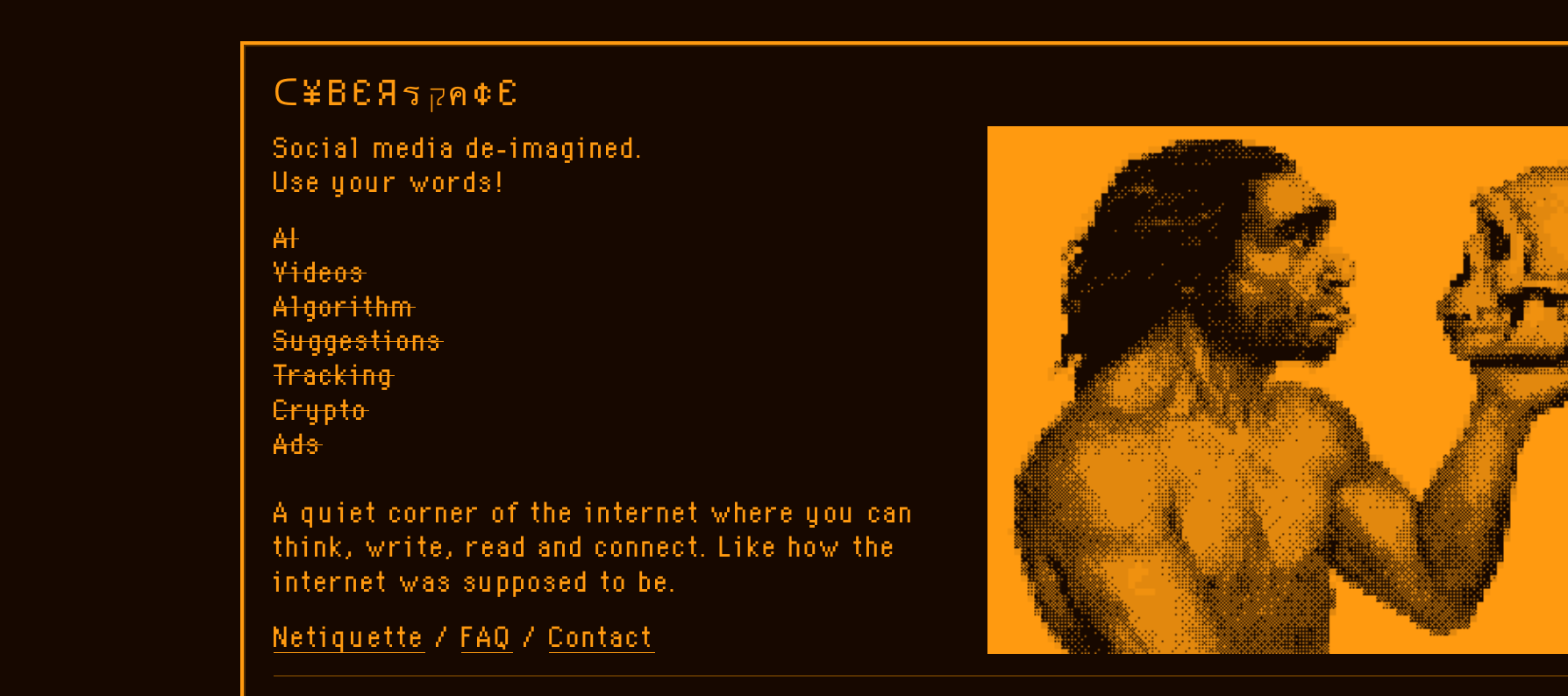
Beyond all the nostalgia, the platform is based on the idea of predominantly text-based communication: images are displayed in a more or less rough pixelated form, and the platform does away with video content, algorithms for sorting and recommending content, and much more. With its focus on reading and writing, Cyberspace is apparently attempting to combat the enshittification of the Internet.
How did we get here?
Even with all this return to the original ideas behind the Internet and the World Wide Web as global infrastructures for the open exchange of knowledge, there’s no need to sacrifice features. Since the release of Cyberspace, the lead developer—with the help of several other developers—has been adding updates and new features almost daily. The minimalist platform has thus evolved into a kind of online operating environment, featuring a whole range of new functions, an API, and a couple of interfaces like a 3D environment or a Graffiti wall. This labor of love is sustained not only by continuous development but also by the volunteer efforts and financial support of its user base.
Within eight months, by the end of June 2026, Cyberspace has approximately 11500 users, contains over 29000 posts, and 100000 comments. New users tend to discover the platform through digital word of mouth. With the exception of a few posts in r/Cyberdeck, a DIY community inspired by William Gibson’s Neuromancer, and on sites like Hackaday or Hacker News, the platform remains a well-kept secret. Consequently, new users are thrilled when they stumble upon the site and discover a place that reminds them of those old days—whether they experienced them firsthand or simply miss them despite never having known them. As the platform’s offerings show, it’s completely irrelevant whether the focus is on BBS, the blogosphere, or specific hardware.
And so Cyberspace bears very little resemblance to what has traditionally been associated with the term. After Gibson coined it to describe a data sphere decoupled from physicality but also thoroughly commodified, the term came to describe the emerging World Wide Web during the 1990s. In his Declaration of the Independence of Cyberspace, John Perry Barlow elucidated what cyberspace was capable of doing discursively: The spatial metaphor made it possible to conceive of the communications infrastructure as a territory, as a “home of Mind,” over which the governments of the old industrial world supposedly have no sovereignty. What had been a dystopia had become a cipher for a space of possibility free from domination.
As early as 1995, Richard Barbrook and Alex Cameron had demonstrated in their critique of the Californian ideology that this freedom from structures of domination is a farce. Referring to the World Wide Web as cyberspace in the way Barlow and many others did obscures the state-funded origins of communication infrastructures, the persistent societal inequalities, and the commodification that began to really took off with the dot-com boom. Instead of serving the ideology of Silicon Valley, the two authors called for a different conception of cyberspace—one that would exist between the state, the market, and the ethics of free software.
By virtue of the self-description as „home-grown Internet away from the cyber malls of the corpos“ Cyberspace as a platform seems to share the critique of the now ubiquitous Californian ideology. It could be contextualized within the Indieweb, even though the network architecture here is clearly not distributed or decentralized. But even so, I wonder what exactly is the enduring appeal of cyberspace—beyond all nostalgia—that continues to this day. What do we actually get out of Cyberspace?
False Promises
Lightness is the ecstasy of communication without irony, it’s the lie of disembodied cyberspace.
– Kraus, Chris (1998): I Love Dick. Los Angeles: Semiotext(e), 204.
I was reminded of this quote that I had saved on tumblr a couple of years ago. In Chris Kraus’ famous book, the protagonist writes another love letter to Dick and fleshes out the idea of subversive transcendence: Rather than desiring a state of immortal lightness, we should think of transcendence as the willingness to work through the materiality of the world and its representations to become someone else eventually. Lightness then, in the protagonist’s (and most probably Kraus’) view, is “Pop Art, early Godard”, i. e. an old idea in which the all too familiar acclaims the status of something unfamiliar, cool, and new that remains superficial. With regard to cyberspace, this idea is warmed up through sociotechnical innovation: The Internet allegedly acts as some kind of microwave for transcendence as getting rid of irony, of certainty and speaking in earnest. From this perspective, irony should not work online: A tweet cannot wink.
Cyberspace evokes lightness – the ecstasy of communication without irony – as a false promise, according to Kraus. Well, I’ve experienced some lightness on tumblr for instance. There were ecstatic moments which stemmed from its role as a tool of discovery rather than communication: People were sharing content for sharing’s sake (and a little interest in their curational self). I still attribute some lightness to it since it was easy to use, but it was especially easy to discover something. Discovery on tumblr felt like getting to know, what was unknown to me at the time; no strings, winks or other traces of irony attached. The platform supported my interest in discovery through browsing the World Wide Web as the already dying blogosphere did before. Without arguing against Kraus bigger argument for another understanding of transcendence, I am wondering about the relation between Cyberspace, communication and irony: How to indulge in the supposed ecstasy of communication without irony, especially online? Is it possible or just an old dream upcycled into a naive imagination of possibility?
For the purpose of this essay, I will assume that the observation of this form of communication seldomly being achieved among (large) groups, but rather in conversations between two to three participants is self-evident. Some situations that spontaneously come to mind: That chat between you and one of your best friend and one of you has just been dumped, a longer conversation on a forum regarding a really niche interest or the search for the right product to acquire, the e-mail chain with an online penpal you never met in real life. All these situations are located within what once was called cyberspace yet have to be removed from its vastness and the supposed wisdom of its crowds. For communication without irony, you need a niche, a conversation between two, a little bit of trust? Just something to rely on.
Digital Media and the End of Irony
But what about irony and its absence? Can we just oppose irony and sincereity? The answers to these questions depends on our understanding of irony. To make just one distinction, we may think of irony as rhetoric, a polemic way of speaking out, on the one hand and the irony of fate on the other. With the former, we tend to conceal our motives in the name of humor and distance ourselves from the subject matter. The latter refers to insights into our paradoxical relation to the world – as a realm of ideals and of reality – that can be held true by a larger set of people, think of Rousseau’s classic ‘Man is born free, but he is everywhere in chains’. The two terms share a common core: Nothing is what it seems like in the first place. This becomes evident in Kraus’ book: The protagonist encounters love where there evidently is none, writes love letters full of fantasy and desire that remain largely unanswered, and continues with a marriage despite being unhappy. All these ironic observations, spilled out in rhetoric, converge on the irony of feminist existence under patriarchal circumstances. On a meta-level there even is the irony of Dick working in media theory and the protagonist resorting to actually writing him all these letters. Through the different styles of writing and engaging with the medium of written language the protagonist becomes aware of her fantasies and the circumstances of her existence.
Irony thus becomes apparent through media and the way we use them. At least, there seems to be a tendency in certain media to foster self-reflexivity. Before I finally turn to digital media, it seems worthwhile to further contextualize ‘I Love Dick’. The book doesn’t easily fit within the category of the novel. Most of the actions within it have happened in some way or another, however defamiliarized. Nowadays we would firmly categorize it as work of autofiction and associate Kraus with Didier Eribon, Annie Ernaux, and Rachel Cusk – just to name a recommendable European few. As a work of autofiction and thinking of the social circles Kraus engages with, it can also be embedded in a debate on the use of irony in literary writing. David Foster Wallace famously juxtaposed television culture and the prose of young male postmodern writers in the U.S. for their cultivation of “irony, poker-faced silence, and fear of ridicule” (171), with the consequence being an individualized culture, built on the circulation of shame and the imperative to say what is opposite to what is meant. The culture of irony establishes a void between cultural production and the possibility to pick up on the world’s problems.
In response to his observations, Wallace advocates for a new sincerity in literary writing as form of rebellion against the culture of irony, that is, forget the guilty in your guilty pleasures. This response was termed ‘post-irony’ later-on and I think it is precisely, what I Love Dick is about. For Kraus and her protagonist, writing becomes means to cut through the pseudo-intellectual pursuits and mannerisms of their social circles and to articulate what is experienced, imagined, felt and therefore already real. Her book counts as a manifestation of working through the irony.
The Internet has always been associated with such emancipatory potentials for the individual. It reduces the costs for the transmission of information for the many and affords numerous ways of communicative interaction between sender and receiver. Steven Levy’s hacker ethic alluded to these potentials even before the Internet as we became to know it during the 1990s, when he summarized how hackers saw the tool in their hands. To just recite two of its aspects: “Hackers should be judged by their hacking, not bogus criteria such as degrees, age, race, or position”; “Computers can change your life for the better”. The dream of many-to-many communication, without the usual gatekeepers and the norms that enforce our feelings of shame, is part and parcel of the notion of cyberspace.
The rise of social media, however, has added a twist to this potential. For the individual, it affords the chance of their message to be seen by millions, however unlikely this may be. Meanwhile, the companies that operate the platforms gain immense structural power over the visibility and distribution of content. The rise of the Internet has developed into a hybrid media system in which a wide variety of media formats converge, but which is increasingly oriented toward opaque algorithmic sorting and distribution mechanisms. Under these conditions, it is resentment that can most effectively attract the attention of the masses. And sometimes I believe that collective actors employing Meme culture to be the harbinger of this trajectory, including a post-ironic to use them as a means to radicalization even leading to instances of violence and murder. What Wallace had observed in television culture, seems to have just deepened with the platform economy into nearly every aspect of our lives.
A question of time
In this context, Cyberspace could well be seen as precisely the right medium for communication freed from irony, as an ecstatic medium for text-based interaction, a niche for the cultivation of trust. Common commentaries on the look and feel of the interface point toward this. Users are relieved to find a clutter-free environment for writing, reading and the ways of interaction built upon these techniques. For example, people comment on the good vibes, someone wrote “I want the web to be read, not performed”, and another user put it a bit more straight forward: “i think the thing i like the most about this website is the complete absence of cynicism”. The prospect for Cyberspace seems to be that it flourishes as long people continue to follow their interests, see the topics, and engage on the basis of relative anonymity, reading and writing. And I think, these limitations are some of platform’s strongest assets: To go against media convergence and prohibit the use of other content than text takes away from the deepening of resentment, i. e. the cultivation of feelings of shame surrounding supposed body norms or the ironic gesture between text and image as seen in memes. I think, the values of these limitations should be kept in mind for future development and the rollout of new features.
The downside of these limitations, however, could be the question of how conversations on Cyberspace can be made permanent. The different applications appear helpful because they distinguish between forms of communication (feed, cIRC, cMail), allow switching between these forms, and enable users to sort content themselves (feed, following, friends, watching and topics). Cyberspace affords several possibilities for continuous conversations already. The thing with digital media affordances though is that they can only point to common ways of usage and thus remain open to the appropriation of its users. At the moment, I see a lot of content revolving around the platform itself, and I’m simply curious to see if and how these sometimes somewhat self-referential conversations will develop and diversify. That is, I would love to see this platform grow beyond the nostalgic vibe and still function as a the much needed niche for a communication without irony. It’s a question of time.